
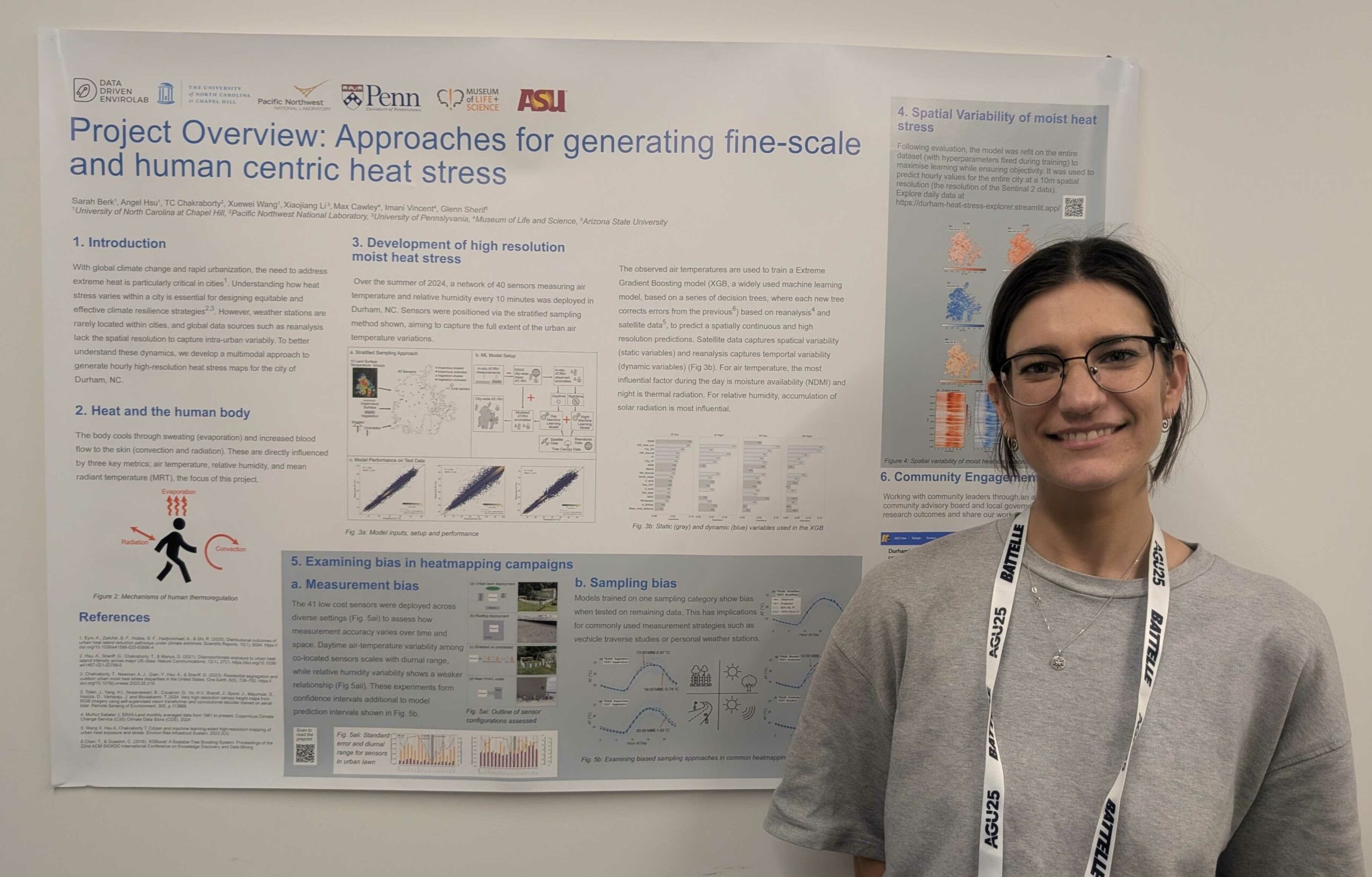
Sarah Berk, with her poster, presented at AGU25
This December, I headed to New Orleans to attend the American Geophysical Union (AGU) Fall Meeting, one of the largest international conferences for Earth and space sciences.
Presenting Urban Heat Research
Tuesday morning began with presenting “Development of an hourly machine learning model for spatially disaggregating urban moist heat stress” in the Advancing Representation of Urban Processes and Dynamics in Models Across Scales session. I enjoyed conversations after the session about the importance of obtaining high resolution heat stress data, and how we can scale this method to other cities in varying climates.
On Thursday, I took part in the Early-Career Researcher Showcase in Urban Systems Research, a new session at AGU this year. This session was designed as a space for early career researchers to give broad overviews of their work, rather than focusing on specific results. Alongside my role as co-convener and chair, I also presented an overview of various work from the project Exploring Disparities and Solutions to U.S. Urban Heat Stress and Climate Justice, titled “Approaches for generating fine scale and human centric heat stress”. The session format was “GeoBurst,” consisting of a 5-minute oral presentation, immediately followed by a poster presentation of the same material. The oral presentation was a true test of timing as slides auto advanced every 30 seconds, but the presenters all excelled! Moving straight into the poster session made for lively and in-depth discussions, allowing ideas introduced in the talks to be explored in much more detail.
An Emerging Theme: Urban Trees
Urban climate research was a clear theme at AGU25, reflecting increasing recognition of its importance under a changing global climate and rapid urbanization. Across many sessions, many presentations focused on exploring mitigation strategies for urban heat stress. While albedo modification measures such as cool roofs were frequently discussed, there was particularly strong emphasis on urban trees and afforestation.
Established research has shown urban areas with abundant trees and green space are cooler, but researchers are now developing ways to quantify, model, and represent these effects. Studies are moving beyond simple vegetation indices (such as NDVI) to include heightening levels of detail in vegetation characteristics, such as height, leaf area, and canopy structure. Urban canopy models, simplified representations of an urban area, typically do not contain representations of urban trees as they balance complexity against computational cost. New research focuses on the incorporation of urban trees, alongside improved representation of urban canyons, wind flow and ventilation. The relationship between urban climate and trees is not one-directional. Presented research demonstrated how the local environment impacts plant phenology. One such presentation showed us how Artificial Light At Night (ALAN, my favorite acronym of the conference!) can alter seasonal cycles such as when leaf drops occur.
Overall, AGU25 was an energizing space to share research and ideas, make connections, and highlight the importance of bridging data, models, and lived experience as urban heat becomes an ever more pressing challenge.
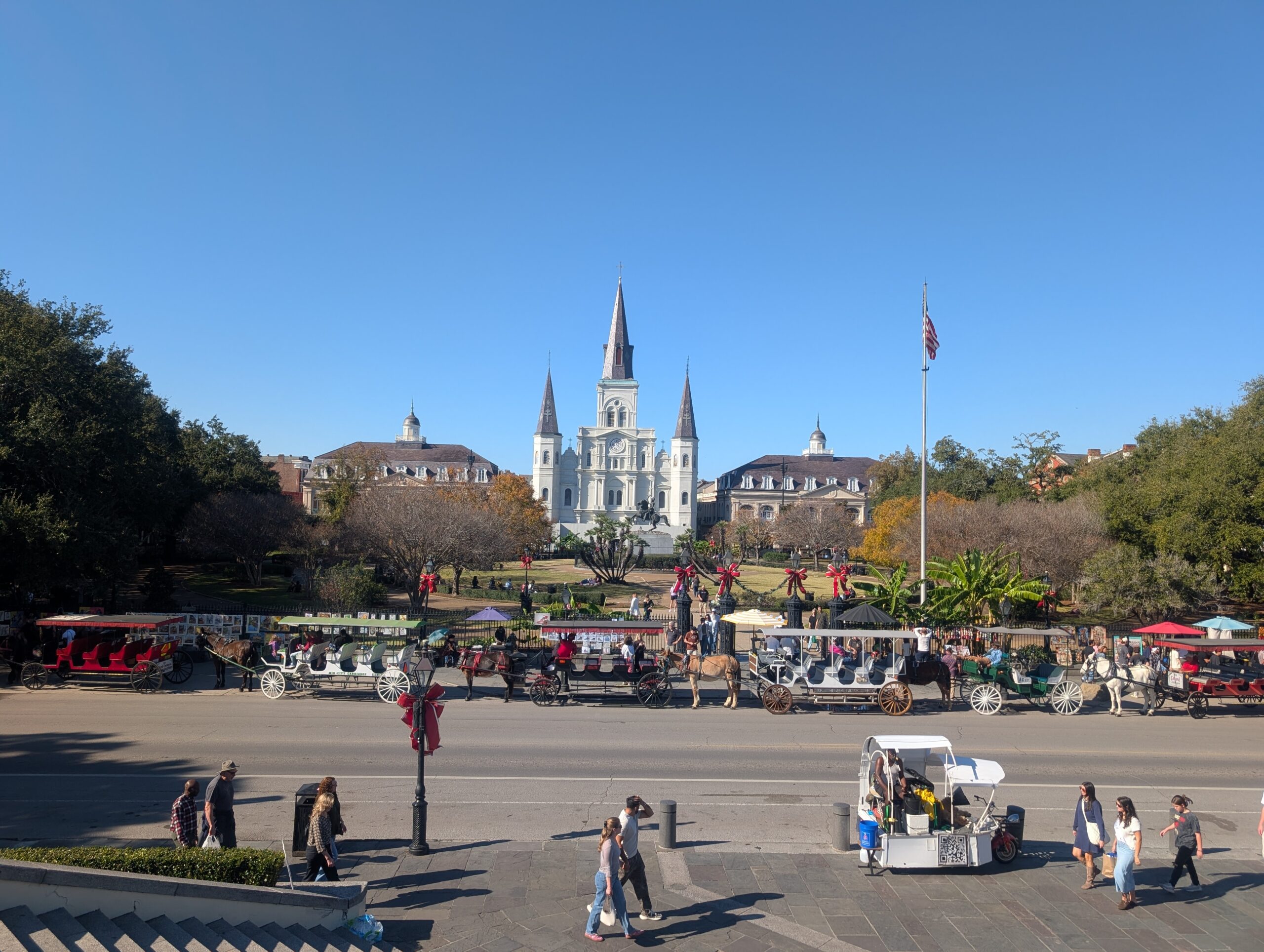
Scenes from New Orleans at AGU25
