

A new peer-reviewed study led by Kaihui Song and colleagues presents the most detailed national assessment to date of how rising temperatures will intensify disparities in moist heat hazards across the United States by the end of the century. This interdisciplinary research, a collective effort by authors from UC Berkeley, the University of North Carolina at Chapel Hill, Pacific Northwest National Laboratory (PNNL), and Princeton University, was published in One Earth. The findings show that climate change will not only increase the overall risks of exposure to dangerous heat, but will also disproportionately burden specific demographic groups such as people of color, older adults, and residents of Southeastern states.
Drawing on multi-model climate projections and county-level sociodemographic data, the study finds that communities already facing heightened vulnerability will experience the greatest increases in future heat exposure. According to the report, “heat exposure is projected to rise across all groups, but the magnitude of increase varies substantially,” with the largest disparities emerging in Florida, Georgia, Alabama, and Mississippi. 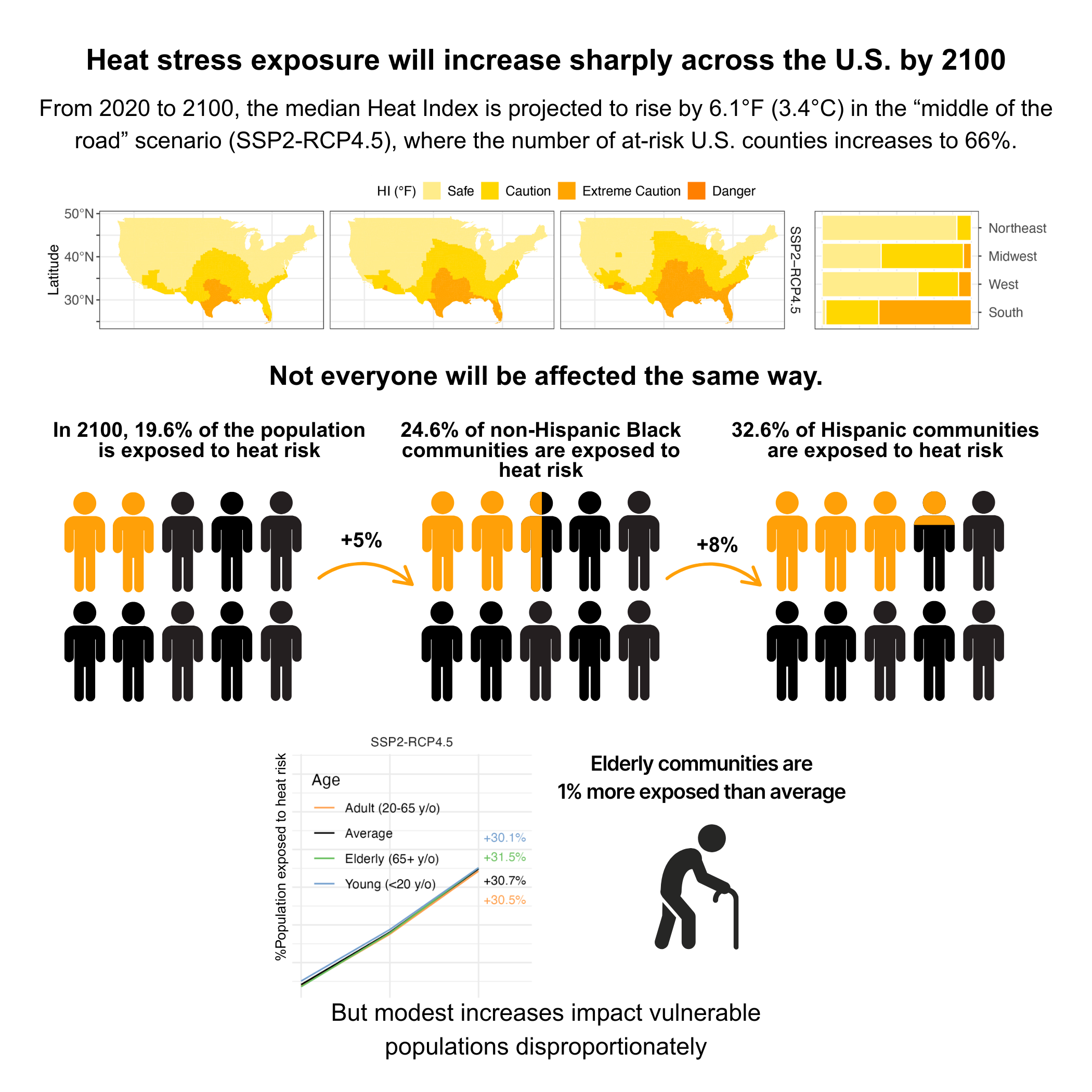
The authors show that without significant climate mitigation, the gap in extreme heat exposure between non-Hispanic Black and non-Hispanic White populations will widen dramatically throughout the 21st century. The lead contact, Prof. Angel Hsu, who leads the Data-Driven EnviroLab said,
“The research also highlights how older adults, already more susceptible to heat-related illness, will encounter some of the steepest increases in dangerous heat days.”
Lead author Kaihui Song, a postdoctoral researcher from the University of California, Berkeley, noted that targeted investments in heat mitigation, resilient infrastructure, and social services will be essential to protect the country’s most vulnerable populations, saying,
“Our findings underscore the urgent need for equitable adaptation strategies.”
The study also emphasizes that future outcomes depend strongly on global emissions trajectories. Under high-emissions pathways, extreme heat exposure increases far more rapidly and unevenly. Under lower-emissions scenarios, disparities still grow but remain smaller, demonstrating that mitigation efforts remain “critical for reducing the scale of inequitable heat impacts.”
This research provides U.S. policymakers, public health officials, and community organizations with actionable insights to prepare for intensifying heat hazards. The study’s authors call for locally tailored interventions, particularly in fast-growing and lower-resourced regions of the South, where demographic vulnerability and climate risk intersect most sharply.
The full article, “Projected widening of sociodemographic heat disparities in the United States by end of century,” is available online at One Earth.
Contact: Kaihui Song (kaihuis@berkeley.edu), University of California, Berkeley
