

On 15 December 2025, the CAMDA community met around a familiar climate challenge: we have no shortage of initiatives, coalitions, and commitments, but we still struggle to measure what they deliver, compare progress across efforts, and translate activity into a clear picture of real-world transformation.
The CAMDA (Climate Action Methodologies, Data and Analysis) collaborative exists for exactly that gap. Since 2016, it has served as a bridge between the UNFCCC ecosystem and the researchers, data providers, and practitioners who can make climate action tracking more credible, comparable, and decision-relevant. The Data-Driven EnviroLab (DDL) took over as the CAMDA Secretariat in 2021.
COP30’s Action Agenda: big ambition, bigger measurement challenge
The Brazilian COP30 Presidency reinvigorated the “Action Agenda” – a critical pillar of the UN Climate Change conferences that focuses on mobilizing businesses, cities, investors and civil society (e.g., non-state actors) to implement their own climate solutions in support of the Paris Agreement and national government actors. It is broadly organized within six key thematic areas, which have 30 objectives. In the lead-up to the two-week COP30 meeting, the Presidency galvanized civil society actors to submit 482 initiatives across 30 “activation” groups — ranging from methane and superpollutant efforts to forests and deforestation-focused efforts. The NAZCA portal now features a searchable database where you can explore these various initiatives and their collective PAS.
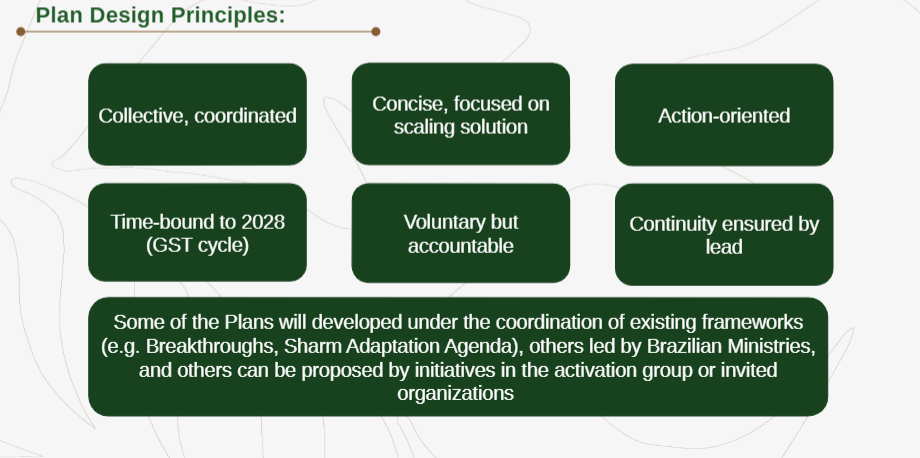
Plans to Accelerate Solutions: the “execution layer” for 2026-2028
To turn these initiatives from simply a catalog of ideas to actual solutions, one of the most practical tools the COP30 Presidency introduced was the Plans to Accelerate Solutions (PAS). The more than 400 initiatives and collaborative partners were encouraged to develop concrete plans designed to accelerate high-impact solutions linked to one or more the Global Stocktake (GST) objectives. Importantly, the PAS are framed within the GST cycle, with a time horizon to 2028, reinforcing the idea that progress should be visible on stocktake-relevant timelines, not only in distant 2050 narratives.
DDL’s PAS: linking NAZCA activity to Yearbook KPIs
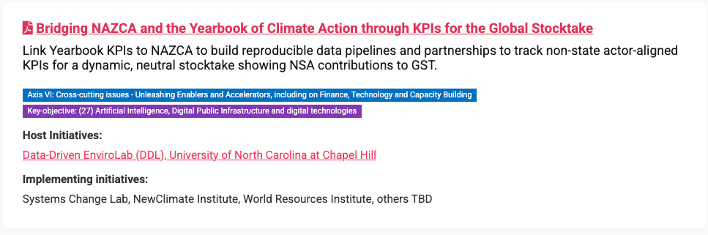
DDL submitted a PAS focused on bridging NAZCA and the Yearbook of Climate Action through a shared set of GST-aligned KPIs for subnational and non-state actors. The aim is to help strengthen the COP30 Presidency’s Yearbook KPI framework by developing complementary subnational and non-state KPIs that can be surfaced through NAZCA. The idea is not for NAZCA to “judge” action, but to enrich what it can show: moving beyond a static registry of self-reported commitments toward a more informative view of real-economy transformation, through indicators like the urban share of renewable electricity, the number of cities with mitigation/adaptation plans, corporate renewable procurement via PPAs, or the reach of subnational policies advancing food-system resilience. In doing so, CAMDA can provide the analytic bridge that links NSA activity to the Yearbook’s GST-aligned barometers, adding the granularity needed to answer the COP30 inflection-point question: what has been delivered, by where, and by whom?
How to plug in
The meeting laid out clear lanes for engagement: join as a data and analysis partner (datasets, methods, tooling), as a technical advisor (review, QA, methodology guidance), or as a funder/resource partner (supporting multi-year collaboration and operations). In the near-term, we are calling for individuals, organizations, data enthusiasts and experts to join our PAS to help make subnational and non-state data part of the solution that can help motivate and sustain momentum, as well as identify where more efforts are needed.
If the climate community gets the data layer right — shared indicators, consistent definitions, transparent methods — we can shift from tracking climate action as storytelling to tracking it as evidence.
To get involved, send us a message on our Contact page.
