
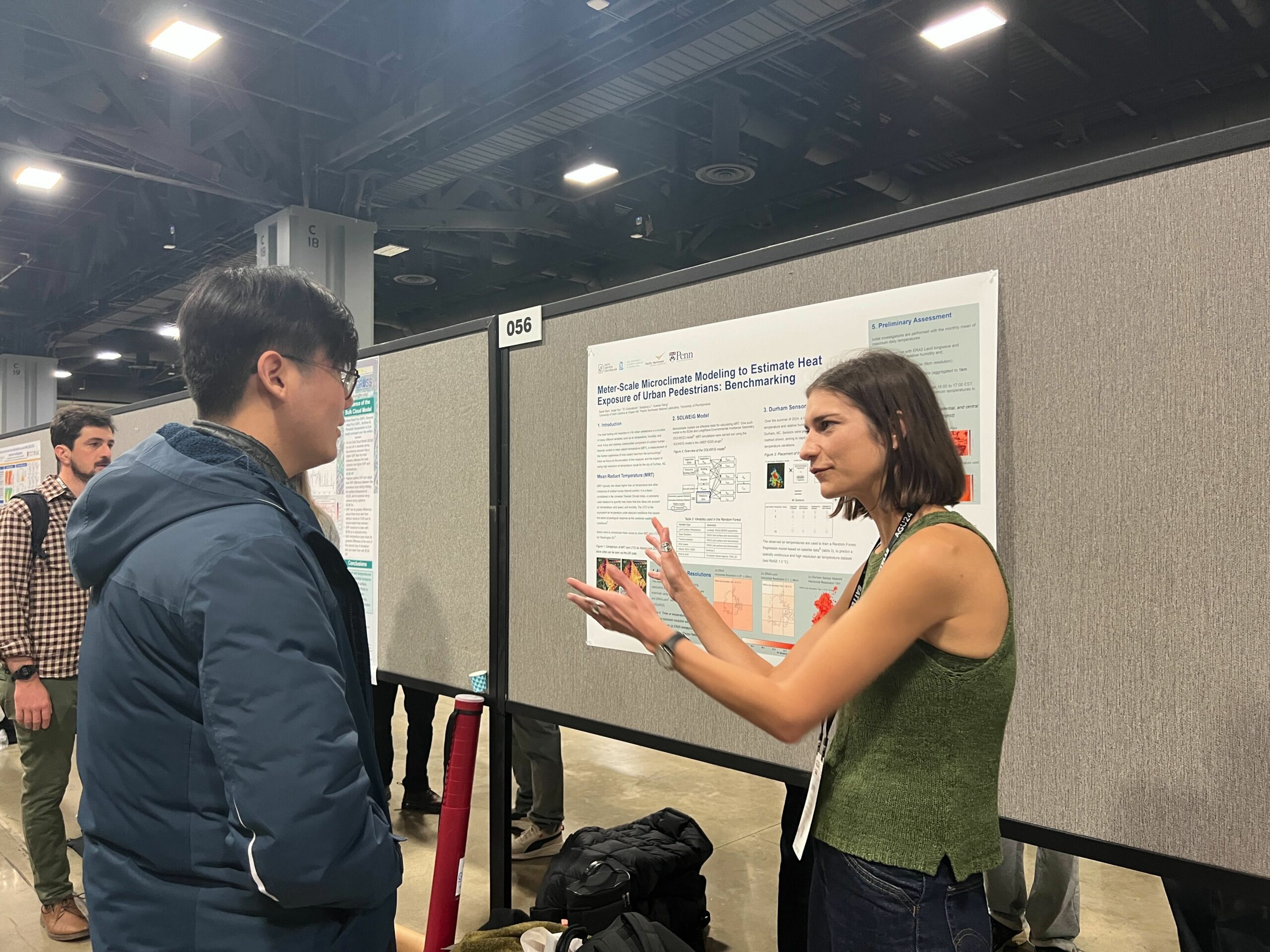
Every year, the American Geophysical Union, AGU, hosts one of the world’s largest gatherings of Earth and space scientists. In December, Washington, D.C. saw over 25,000 researchers, educators, policymakers, and industry leaders from more than 100 countries gather to discuss the conference theme, “What’s Next For Science?”.
Among the attendees were DDL’s Sarah Berk, an urban climate scientist, and Xuewei Wang, a data scientist. Here, they share their key insights and emerging trends from AGU24. The conference truly embodied its theme, sharing novel research and setting the stage for exciting advancements – watch this space for more innovative developments in the future!
High resolution urban data
Intra-city variations in urban environmental hazards require high-resolution data to be effectively studied. AGU24 featured numerous engaging discussions on innovative methods for generating high-resolution measurements for a range of hazards, including air pollution, albedo, and air temperature.
Researchers are leveraging machine learning and AI to generate increasingly higher resolution maps, going down to as detailed as decimeter resolution for urban albedo measurements and exploring more diverse datasets, such as crowdsourced data from personal weather stations. These topics gained lively discussion alongside DDL’s work simulating meter-scale maps of pedestrian heat exposure.
The application of these datasets includes highlighting inequalities in urban environmental hazards and developing targeted solutions. Results in this area are beginning to emerge, and we hope to see further growth at next year’s meeting!
In-situ measurements
In situ or on-the-ground measurements are essential for physics-based urban climate models, as they are required to confirm that they are effectively simulating real life. Without these, there is no way to make comparisons across different models and improve model performance. Within the urban climate modeling community, obtaining observations to validate physics-based models remains an active and vital area of research.
AGU24 showed new and innovative methods to create appropriate and sufficient in-situ measurements. These ranged from detailed long-term measurements of Photovoltaic Panels, which can warm or cool urban air temperatures, to drive-by thermal heat mapping that can map thousands of buildings in an hour.
With these measurements, researchers can start to integrate more complex schemes into their models and evaluate the performance of such schemes. Combined with the ever-increasing computational developments that speed up processing times, watch this space for increasingly detailed physical representations of urban processes in the future.
Machine Learning
The advancements in machine learning for global emission monitoring were another highlight at AGU24, showcasing the transformative potential of these new technologies in addressing urban and global climate challenges. Xuewei had the opportunity to meet with researchers pioneering the use of remote sensing and machine learning models to quantify on-road transportation emissions. Their work demonstrates how high-resolution data and ML algorithms can provide valuable insights into emission hotspots at a city scale. Additionally, industry leaders like IBM introduced an advanced ML tool designed to measure greenhouse gas (GHG) emissions from data centers and freight transportation. This innovative tool could reveal how emissions are generated from sectors or areas related to emerging technologies. These developments underscore the growing role of ML in enhancing the accuracy and scalability of global GHG emission monitoring. As these methodologies continue to evolve, we hope they will bridge the gap between data-driven science and real-world environmental action.
