
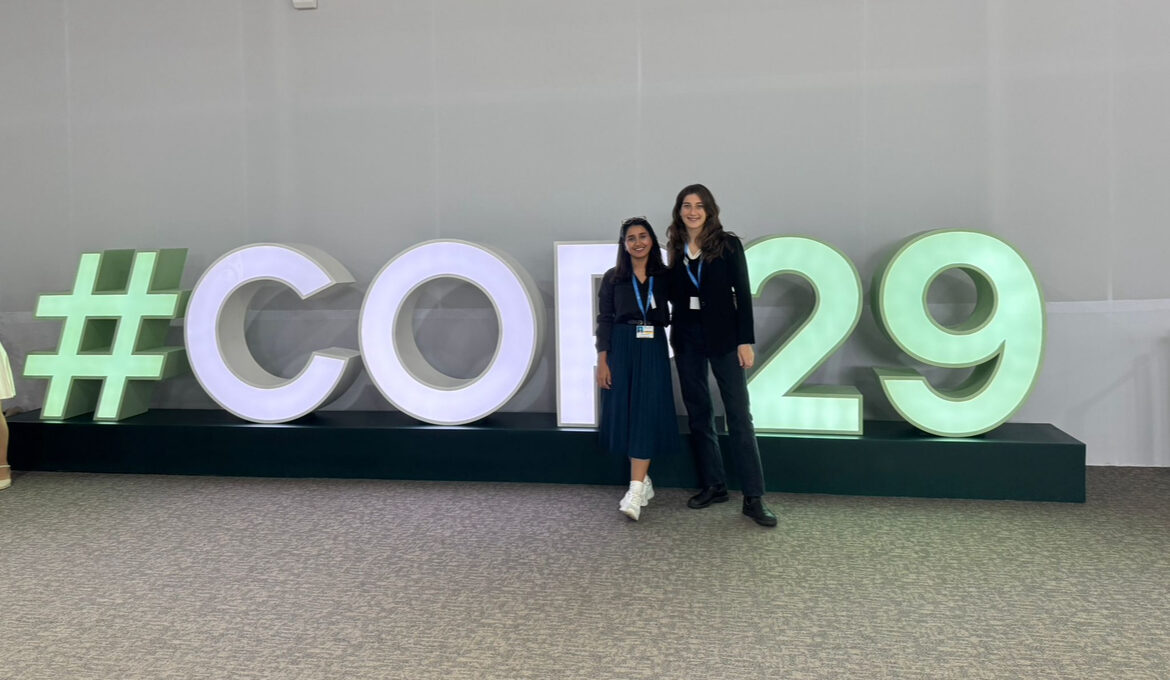
Students Ummamah Shah (left) and Margot Francini (right) representing Duke University and UNC-Chapel Hill as delegates at COP29
In November, UNC-Chapel Hill selected senior Margot Francini and fellow junior Maanya Rajesh to join 50,000+ attendees, including members of the DDL team, at the United Nations 29th Conference of Parties, COP-29, in Baku, Azerbaijan. After spending Week 1 of the conference in Baku, Margot shared her experience and takeaways with the DDL. The following is a blog written by Margot and edited by DDL’s Nicholas Pell.
Margot Francini’s Reflections on COP29
First Impressions
This year, I was privileged to represent UNC-Chapel Hill in the first week of COP29 in Baku, Azerbaijan. My strategy ahead of this conference was to build on the interests I cultivated throughout my undergraduate career and learn more about the finance frameworks that shape most of the conversations at COP.
During my first couple of days at COP, I cast a wide net for the types of events I attended to see what I wanted to focus on for the rest of the week. Each morning, I reviewed the extensive daily schedule published overnight, adding mandated dialogues between Indigenous knowledge holders, panels on energy transition implementation, working group consultations on the operationalization of Article 6 of the Paris Agreement, and the beginnings of negotiations surrounding the New Collective Quantified Goal (NCQG) for climate finance to my schedule.
Focus on Climate Finance
The NCQG discussion was central to this year’s COP. A new funding goal for global net-zero transitions had to be decided by 2025, and leading up to COP, there had been great debate surrounding what that monetary sum would be, where it would come from, and in what form developing nations could receive it. Watching the preliminary negotiations, I saw each country and party coalition make their interventions, laying out their positions on best moving forward with the climate finance goal based on the framework guiding their work for the past three years.
Divergent Perspectives
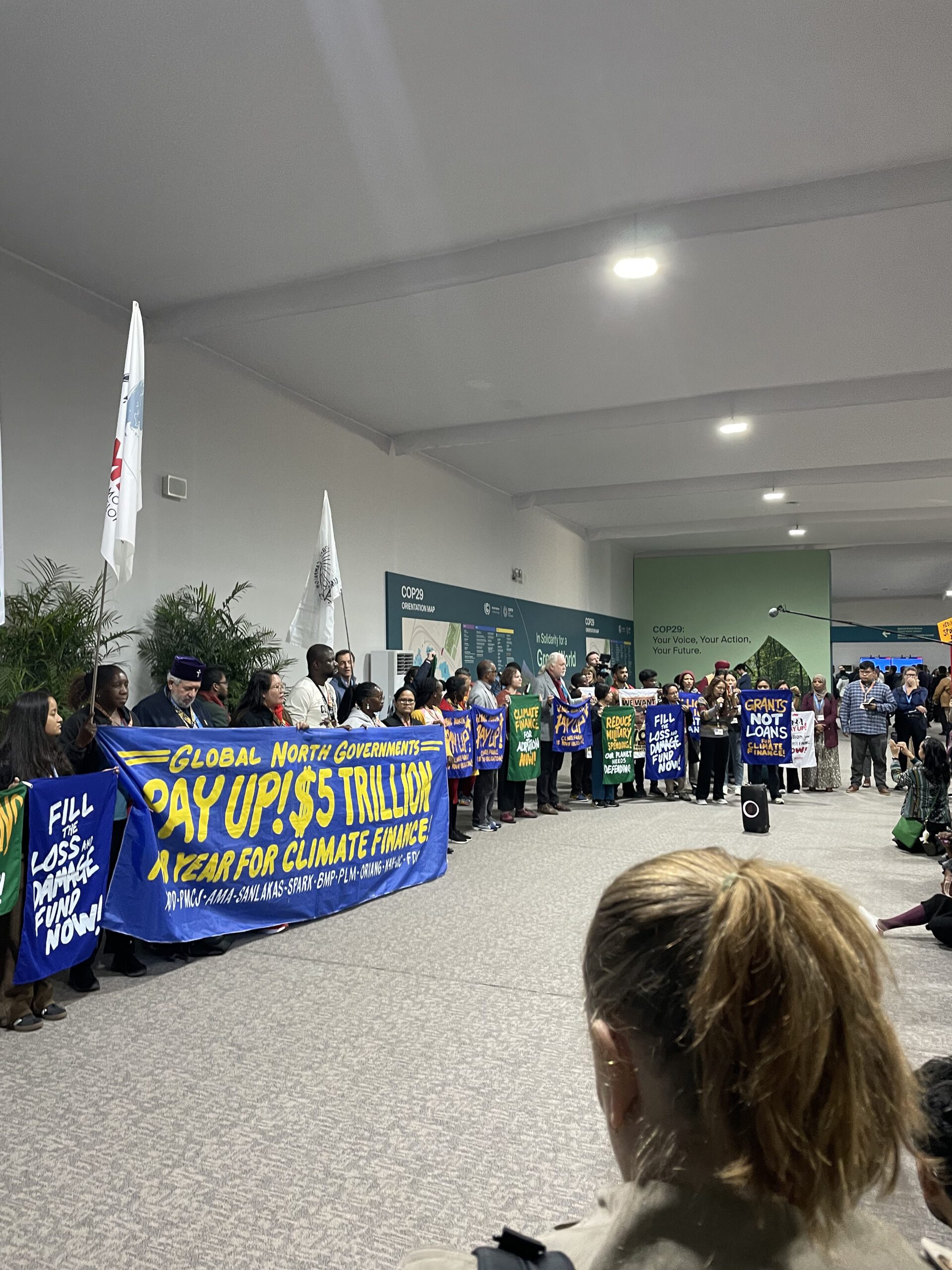
“Through these interventions, I saw two positions emerge: those of the ‘developing countries’ and ‘developed countries.'” – Margot Francini
While the United Nations used the terms “developing” and “developed” throughout negotiations, from here on out, I will refer to these groups as the “Global South” and “Global North,” respectively.
The Global South’s Perspective
Most of the Global South countries and coalitions laid out their positions first. This group includes “least developed countries,” which lack adequate funding for advancing their net-zero transitions, island nations facing existential climate destruction, and middle-income countries that have rapidly industrialized in recent decades, such as China and Brazil. In negotiations, these countries advocated for an overhaul of the original NCQG framework, saying that the new goal should specify that historical emitters of greenhouse gasses, such as the United States, should be contributing the most to global climate finance. Nearly all advocated for a substantial increase in the NCQG from the original $100 billion to $1.3 trillion annually.
The Stance of The Global North
The Global North instead advocated for sticking close to a $100 billion floor, funding climate finance through a mixture of public and private sources, and limiting specificity on how much money should come from each nation. The Global North consists of the United States, the European Union, Canada, Australia, Japan, Norway, and other high-income countries. In negotiations, they focused on requesting specific subsections of the text be amended to tighten language and define terms they deemed ambiguous, rather than overhauling the entire text. It was interesting to listen to the conversation between the Global South and Global North, as it oscillated between climate-vulnerable countries, such as Nepal, describing their civilian and budget losses to natural disasters in recent months, to other parties, such as the European Union, describing the inclusion of such realities in the text as “political.”
Finding Common Ground on Climate Finance
Both positions developed and compromised throughout the conference, with parties finally agreeing to a $300 billion yearly climate finance goal. However, the stark disparity between positions was notable in those initial negotiations. There was a palpable tension between the two sides of the room, with the South being specific about their demands for climate finance compensation, and the North advocating for the perpetuation of the status quo. Witnessing this discrepancy, I learned more about the implications that both the historical and present state of a country’s economy have on its abilities to deal with climate change and avoid taking responsibility for the issue. I also noticed the incompatible trends between who vitally needs climate finance, and who holds those funds.
Key Takeaways from COP29
Disparities in Carbon Credit Access
Countries in the Global South are less able to buy carbon credits to help meet their net zero goals than countries in the Global North. Considering that the Global North purchases carbon credits from the Global South, this highlights a critical disparity in access to net zero achievement. The transnational carbon credit purchasing not only primarily benefits the Global North, and therefore, historically emitting countries, but it also increases the risk of double counting emissions reductions. As such, discussions on ensuring integrity and transparency in international carbon markets under Article 6 of the Paris Agreement were a key focus and outcome of COP29.
Economic Vulnerabilities in Developing Nations
Additionally, many island nations and some other countries in the Global South rely primarily on agriculture, fisheries, and tourism for revenue. These industries are all threatened by climate change, especially in coastal communities. If public climate finance is lacking, developing countries must rely more on private investment. However, if there is a high risk of climate disaster in their countries, private investors are less likely to want to invest in renewable energy projects or other climate mitigation or adaptation projects. These countries are caught between a rock and a hard place, with limited ability to move the needle on shaping their climate futures.
Indigenous Nations Left Out of Critical Discussions
Outside of the NCQG negotiations, I also followed UN-mandated discussions between Indigenous leaders from across the world. While incredibly impactful and heavy to witness, these conventions did not involve negotiations or decision-making with implications for international law, as Indigenous nations are not recognized as sovereign parties in the UN system. In adjacent rooms, countries such as Australia and Canada would tout their respect for and prioritization of Indigenous nations’ rights and environmental knowledge during negotiations, while next door, Indigenous nations from these territories would explain how their rights to a livable environment are disrespected daily. These simultaneous but separate discussions highlighted a disjointed conversation surrounding global climate realities. I saw this to be a massive oversight and inefficiency of the COP process, where critical perspectives are being left out of climate agreements, and false narratives are influencing decisions in negotiation rooms.
Lessons Learned and a Path Forward
My overarching takeaway from attending COP29 has been that when mobilizing critical, multilateral climate action with substantial and equitable impact, the Global North’s historical emissions must be accounted for when considering who contributes more substantially to funding sustainable transitions today. However, negotiating climate finance centered on moral obligation and motivating industrialized countries to act without strong incentives or consequences is a great challenge. Still, collaborating on more methods to promote climate justice through the language of the negotiated texts should be of utmost importance moving forward in efforts to protect a shared, livable climate future.
This year’s COP30, to be held in Belém, Brazil, in the “heart of the Amazon,” proclaims to center around Indigenous knowledge and perspectives. Considering my observations from COP29, I am keen to see how substantive this focus will be, specifically in the negotiation rooms themselves. Leading up to COP30, I still have a lot to learn about levers that successfully mobilize net-zero transitions in critical contexts, and COP29 seriously opened my eyes to the complexities of addressing climate change at the scale needed to secure a livable future. The experience has empowered me to fiercely advocate for equitable, informed, and transparent solutions to climate change and air pollution issues throughout my career and beyond.
Want to Hear More?
Margot will be joined by Ummamah Shah, a second-year Masters of Environmental Management student at the Duke Nicholas School of the Environment, Dmytro (Dima) Zlenko, a third-year MBA-Environmental Management dual degree student at the UNC Kenan-Flagler Business School, and Duke Nicholas School of the Environment, and Azar Hasanli, a second-year Masters of Public Policy candidate at the Duke Sanford School of Public Policy for a panel discussing their insights on the proceedings from the COP29 UN Climate Conference. The panel discussion will be held on February 6th from 1 to 2 p.m. EST at the Toy Lounge in UNC’s Dey Hall.
