
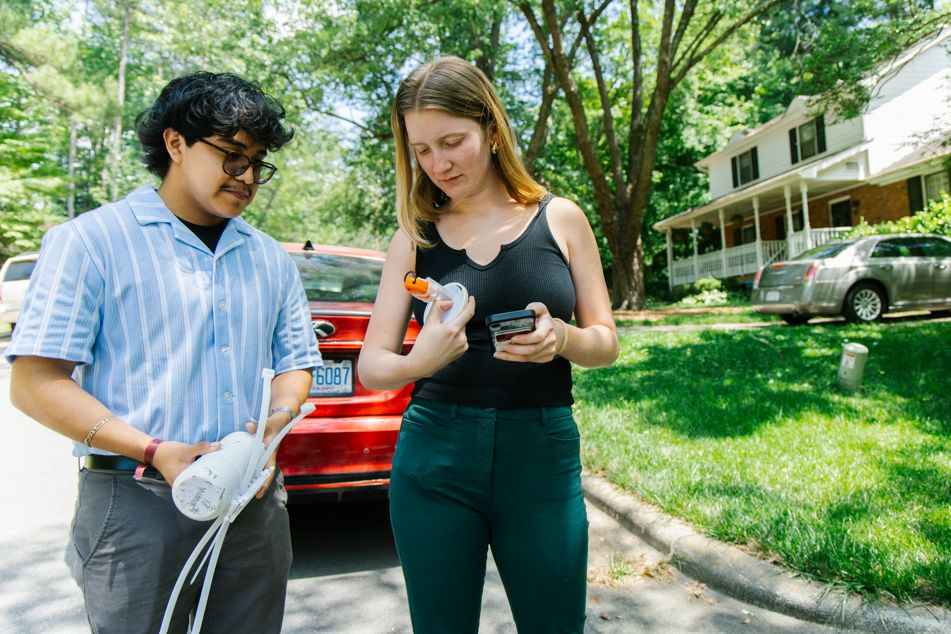
This summer, Data-Driven EnviroLab hosted two student researchers, Vivien Hines and Carlos Carranza, through the 21st Century Environmental Health Scholars Program, a federally funded collaboration between the UNC Institute for the Environment and North Carolina Central University. Under the mentorship of Dr. Sarah Berk, the students conducted research addressing heat exposure and environmental monitoring in Raleigh, North Carolina. Both scholars recently presented their findings to our board, and we are pleased to share summaries of their work below.
Vivien Hines
Heat Exposure in Raleigh, NC
This summer, I worked alongside Dr. Sarah Berk from the Data-Driven Envirolab (DDL) on research involving heat exposure assessments in Raleigh. I started my research assisting a DDL project evaluating the effectiveness of a new cool pavement treatment being applied to several streets in Raleigh. We wanted to know whether the treatment actually lowered air temperature as advertised. To test this, we set up a network of 60 sensors on treated and untreated streets across the city and measured air temperature throughout the summer. While the analysis for this project is still underway, I wanted to leverage this data for my research presentation and ask a different question: which areas of Raleigh experienced the hottest temperatures?
I ran a physiological heat threshold model that identified exceedances in four heat thresholds (liveability and survivability for younger and older adults) at each of the 60 sensors. Later, I combined these data points with maximum and mean temperature to build a heat exposure index. I then examined economic indicators including poverty, unemployment, and median household income, to identify areas experiencing greater heat exposure and greater economic vulnerability. Combining the heat exposure index and the economic vulnerability index gave me an overall vulnerability index. This allowed me to take data collected for a specific infrastructure intervention and use it to ask a broader question about heat risk in Raleigh, NC.
Moving Forward
I am now working to share the results of this project with the local Raleigh government, community, and local organizations to inform their decision making. A big thank you to all of the people involved in this program, especially Dr. Kathleen Gray and Dr. Angel Hsu for their guidance, as well as Dr. Sarah Berk for her mentorship.
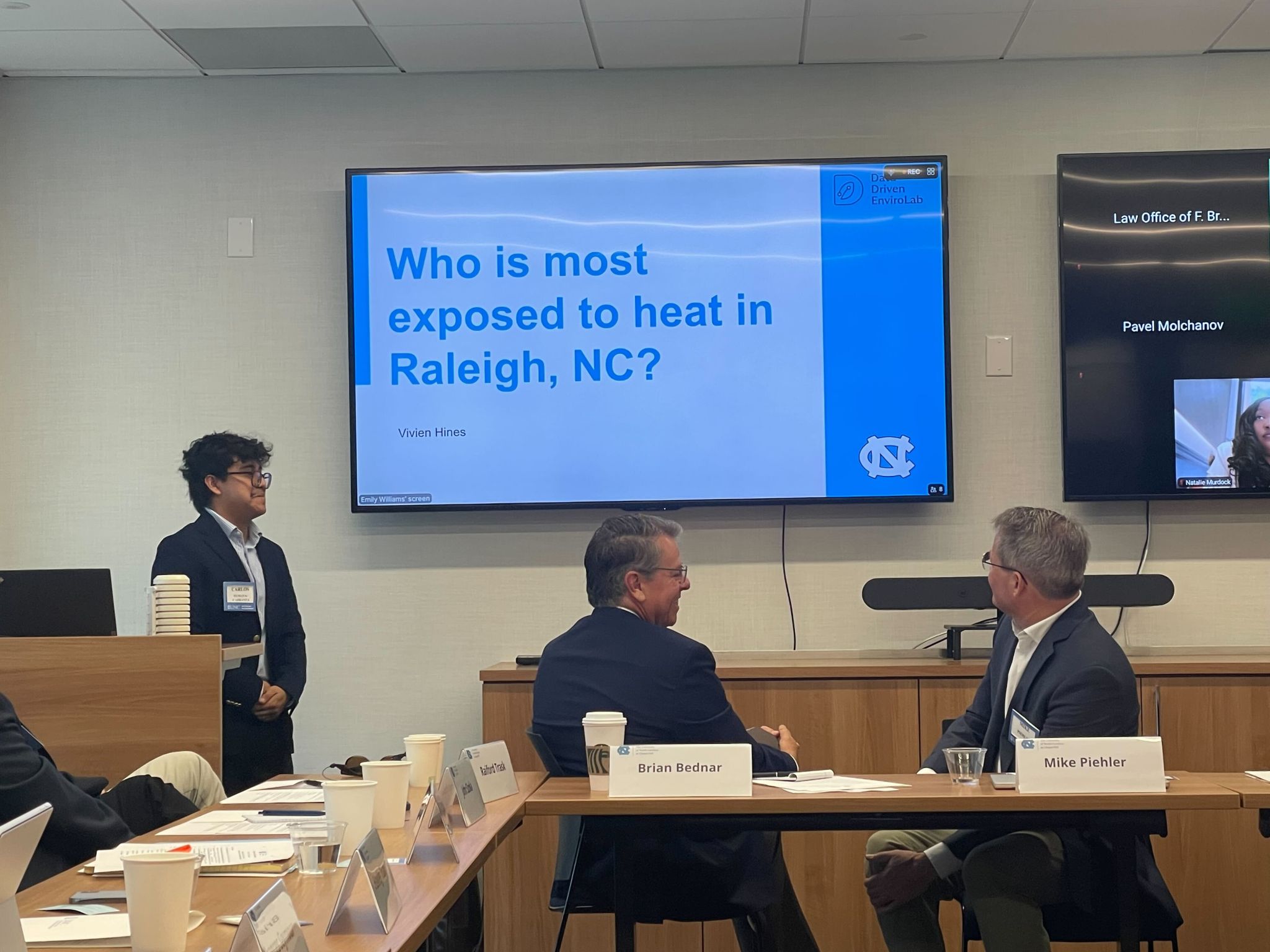
Carlos and Vivien presenting their summer research at IE’s Board meeting
Carlos Carranza
Designing radiation shields
This summer, I worked as a research assistant with Dr. Hsu’s Data Driven EnviroLab (DDL) through the 21st Century Environmental Health Scholars program. I worked with Dr. Sarah Berk to design and develop an actively ventilated sensor shield to reduce solar heating effects and improve the accuracy of low-cost sensors.
Using computer-aided design (CAD), our team developed three different shield designs, each incorporating a solar-powered fan to improve airflow around the sensors. After lots (and lots) of 3D printing prototypes, evaluating, and refining, we 3D printed the final shields out of ABS filament, the same plastic used to make LEGO’s.
To evaluate the shields, we tested all three designs alongside a research-grade shield under identical environmental conditions over a 24-hour period. Our results showed that all the designs helped reduce solar heating of the sensor body, demonstrating the potential of low-cost, actively ventilated shields for environmental monitoring.
I presented this research at the 2026 UNC Summer Research Symposium where I had the opportunity to share my work with people from a variety of backgrounds. This was a proud moment for me because my work was well received – I earned the Top Presenter Award, which recognizes effective science communication, poster, and public speaking skills!
Research plans for the future
I am thinking of testing additional environmental variables such as relative humidity and heat index in the future. I’ve continued working with DDL this fall, and we are currently testing a fourth shield design that incorporates lessons learned from the summer. This version uses ASA filament for improved weather resistance and a stronger brushless fan.
I am incredibly grateful for the opportunity to join the lab. Through this experience, I connected with established researchers and fellow students, received valuable mentorship, and gained hands-on experience in data analysis, digital fabrication, and science communication. Most importantly, I was able to combine my interest in environmental research with my passion for engineering while getting to know the amazing people at DDL and learning from them everyday.
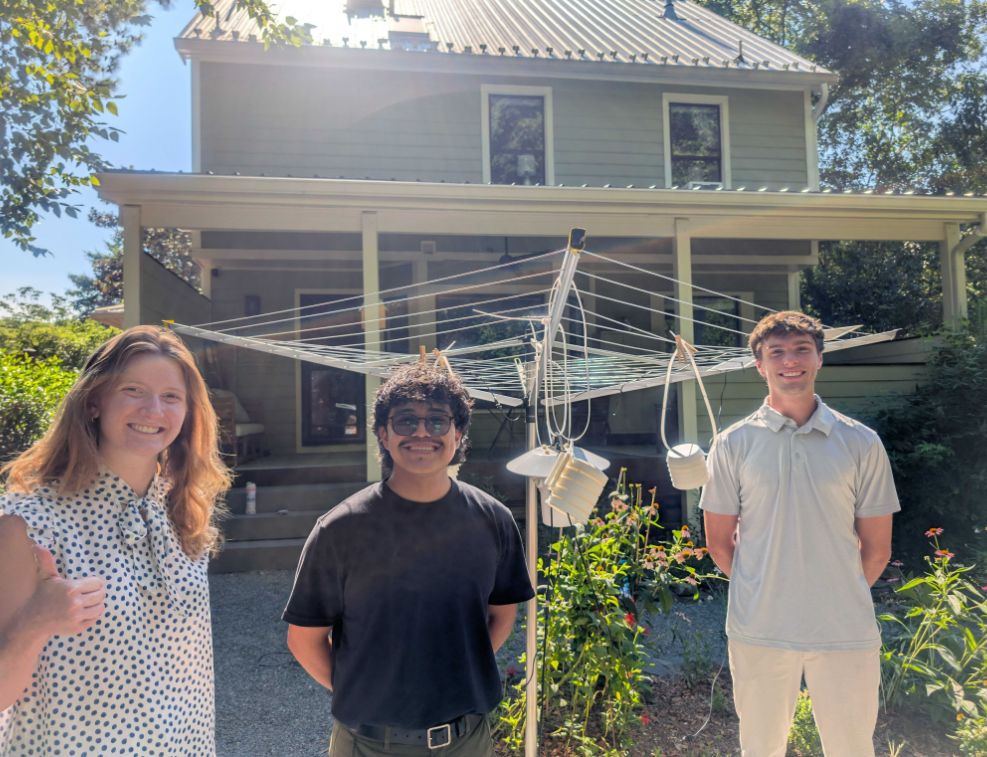
Special thanks to Austin Irwin, our other summer intern, who assisted in the designing of radiation shields and sensor installation during the summer! On his experience, Austin shared, “this summer, I had the opportunity to collaborate with Vivien, Carlos, and Dr. Berk on this project. With this team, I helped with designing new shields with CAD software and 3D printing. As a GIS analyst, this engineering and data collection challenge was new to me and has made me more aware and understanding of the full data pipeline. I am grateful for the opportunity to work with this team as we tackle extreme heat, and am looking forward to continuing our research together!”
