
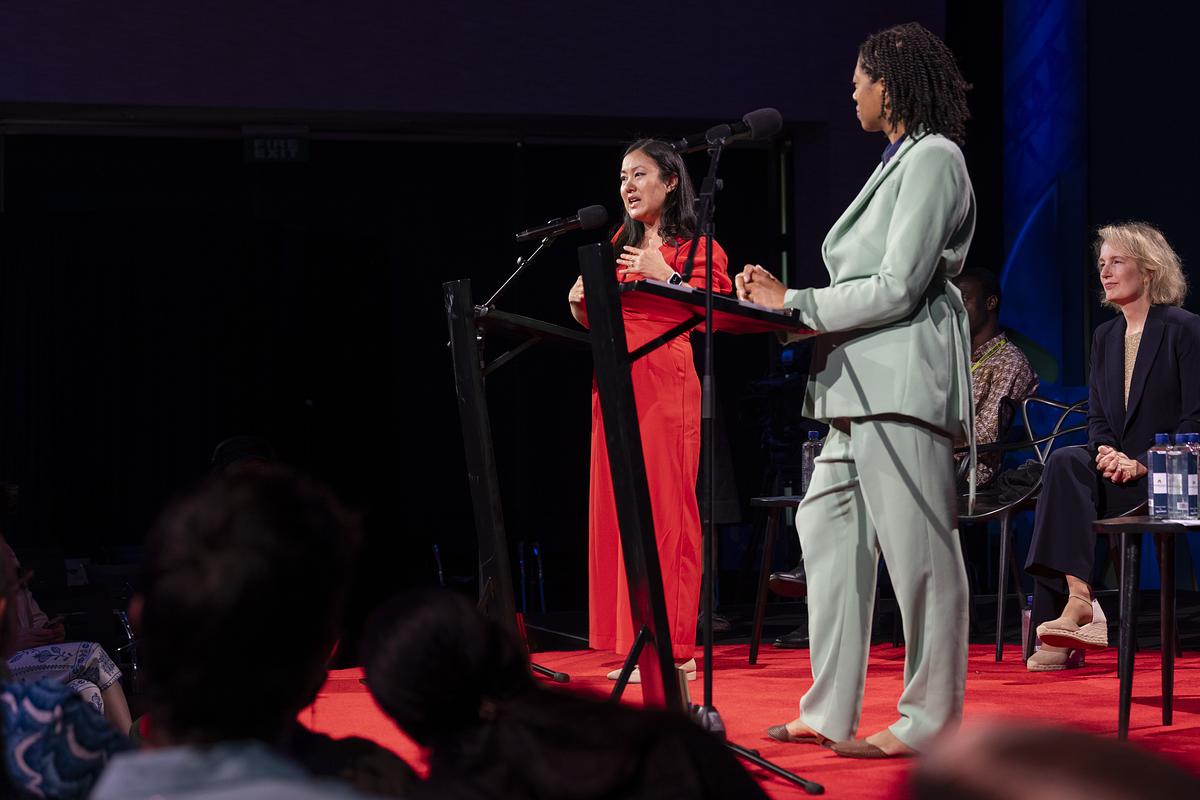
Debatable Workshop at Countdown Summit 2025. June 16 – 18, 2025, Nairobi, Kenya. Photo: Callie Giovanna / TED
At the 2025 TED Countdown Nairobi event, I had the opportunity to join the first Debatable event, where six activists, scientists, business and finance representatives took sides to debate the motion: “1.5 may be dead, but the goal should remain.” We were divided into a “For” and “Against” team, where each of us had three minutes to present our case before a jury consisting of Hongqiao Lu (Shuang Tan), Greg de Temmerman (Quadrature Climate Foundation), and Xiye Bastida (climate activist) weighed and before each team had a 2-minute rebuttal. The audience then voted which side was more convincing in their arguments before sharing their reflections.
As a high-school debate champion myself who competed in both Lincoln-Douglas and Congressional debate events through the National Speech and Debate Association, I was more than thrilled to brush off my rhetorical skills for this. My team, the “For” team, which also featured Philippine de T-Serclaes and climate activist Joshua Amponsem, ended up “winning” against a formidable “Against” team of Marilyn Waite (Climate Finance Fund), Wayne Walker (Woodwell Climate Centre), and anchored by Robert Muggah.
I would’ve been happy arguing either side, since I think both have some merit. In favor of keeping 1.5, we’ve seen how a single, global goal has mobilized countries, businesses and local governments (check out our Net Zero Tracker) to take climate action. But, at the same time, we’ve seen so little movement (global emissions keep rising, there’s a persistent gap between national policy efforts and needed cuts for 1.5, questionable integrity and credibility of net-zero claims, etc.) on 1.5. Robert Muggah rightfully likened this 1.5 credibility crisis akin to purchasing a gym membership without ever going to the gym (incredibly relatable, I must say). What do you think? Should we keep the 1.5C goal, or should we be rethinking whether or not it’s useful, given global average temperatures have already exceeded this critical threshold?
Thanks to the Kite Insights team for organizing a fantastic debate and to TED for inviting me!
See below my plea to keep 1.5.
Reclaiming 1.5C
Listen, 1.5°C was never even alive to begin with — it was never truly given a chance. So the task now isn’t to mourn it or move on. It’s to breathe new life into it. And that starts by reclaiming what it was always meant to be.
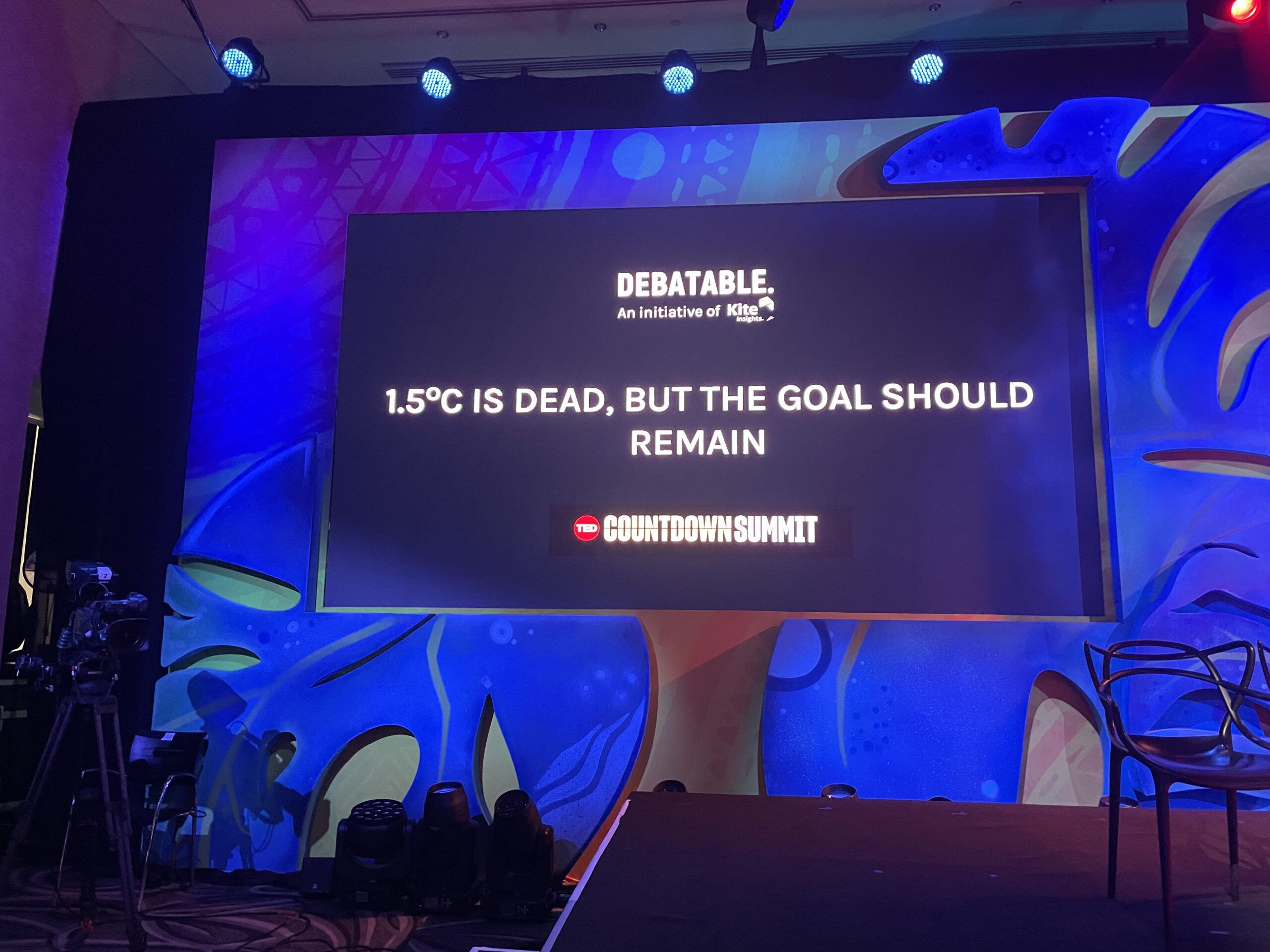
The motion for debate at this year’s TED Countdown Summit in Nairobi.
First, let’s be honest. Scientists never meant for 1.5°C to be a rallying cry. At worst, it’s a data point pulled from obtuse climate models and thrown into global diplomacy – abstract, impersonal and disconnected from the realities it’s meant to represent. Scientists and policymakers adopted it as a North Star, but we never drew the map. We didn’t chart the routes or even explain the destination in human terms. Without that map, most of the world has been left wandering.
Second, we need to stop treating 1.5 like a brittle finish line and start treating it as a living goal, something that can evolve and still guide us. Right now, 1.5 sounds like a pass/fail test that we’ve already flunked. This kind of framing frankly doesn’t work – it turns ambition into despair. But, if we go back to the North Star analogy, 1.5 isn’t a checkpoint we hit once, but a direction we keep steering toward. 1.5 then becomes about reducing harm every step of the way, not just whether we crossed a line.
“If we say 1.5 is dead and stop there, we risk making climate catastrophe the new normal — accepting higher, life-threatening temperatures, higher sea levels, deepening inequality, and a gradual erosion of everything we need today to live healthy, productive lives.”
Without a reboot, we risk collapsing into resignation. If we say 1.5 is dead and stop there, we risk making climate catastrophe the new normal — accepting higher, life-threatening temperatures, higher sea levels, deepening inequality, and a gradual erosion of everything we need today to live healthy, productive lives. So let’s be realistic but not defeatist – the problem isn’t the number, but the story around it. Luckily, we can change the story.
How do we do that? We need to humanize 1.5. Because right now it’s abstract. It doesn’t move people. But what if we translated that number into lives saved from deadly heat waves, into harvests not lost to drought, into coral reefs still teeming with life, and trillions in avoided damages? What if we made 1.5 about clean air in our neighborhoods, about jobs in a thriving green economy, about homes not washed away by floods? A local vision that connects the global goal to what matters most at home. Take Guadalajara as an example – 1.5 means planting over 45,000 trees in hot, underserved neighborhoods and creating 20 green corridors with shade and bike lanes. For Johannesburg it means requiring all new buildings to be low- to net-zero carbon by the end of the decade — cutting emissions while making homes and offices healthier and more affordable.
These aren’t abstract numbers or policies, they’re what 1.5 looks like on the ground. Not just a target, but a destination we can imagine, invest in, and build toward – together.
This is what Reclaiming 1.5 means. Not letting go of the goal, but finally giving it a fighting chance – by making it tangible, local and meaningful for our everyday lives.
