
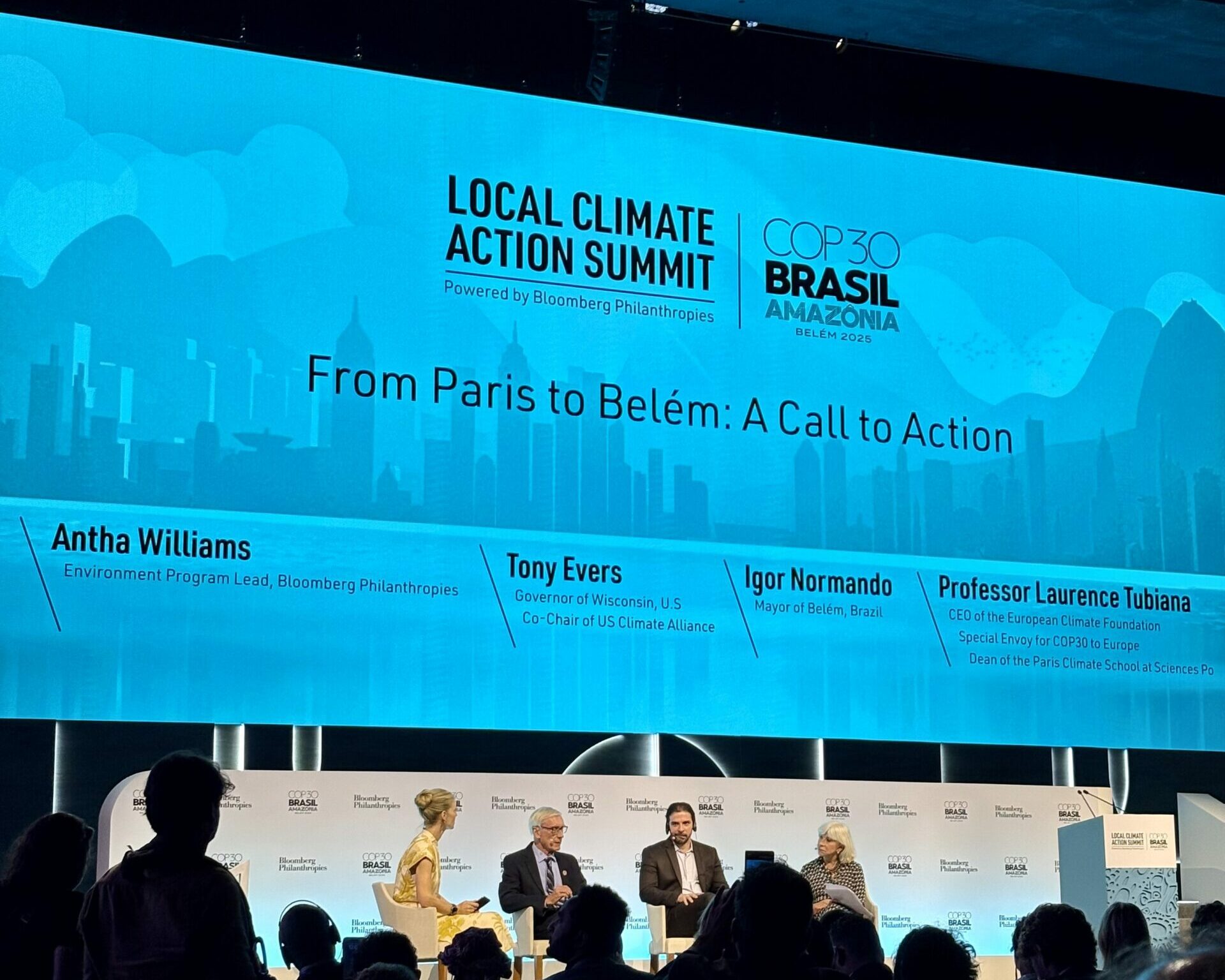
COP30 Local Climate Action Summit Call to Action
The Local Leaders Forum brings together subnational officials from around the world to showcase how local action is driving global climate progress. UNC-Chapel Hill Senior Colin O’Hagerty attended the Local Leaders Forum at COP30 with support from the Data-Driven EnviroLab. In the following blog, he shares his key insights from the event.
Local leaders from around the world gathered in Rio de Janeiro, November 3-5, as part of the C40 Cities World Mayors Summit and COP30 Local Leaders Forum, sponsored by Bloomberg Philanthropies. Ahead of this year’s COP in Belém, this marks the first time the UN has provided an official pre-COP space for subnational leaders (national leaders have had the World Leaders Summit since COP26) and signals the Brazilian Presidency’s commitment to multilevel collaboration and implementation.
Born out of mayoral delegations at the 2012 Rio Earth Summit and COP21 in Paris, this initiative formally recognized the role cities and regions play in addressing climate change.
In the words of Teresa Ribera, the Vice-President of the European Commission,
“the green transition is moving forward on the ground.”
Centering peer-to-peer collaboration and mayoral “Offers of Action” that exemplify solutions-oriented climate diplomacy, this Forum is part of the COP30 Presidency’s “global mutirão,” a mission to unite the private and public sectors with all levels of government to deliver results.

World Mayors Summit 2025
Key Asks from Subnational Leaders Heading into COP30
1. Acknowledgement and inclusion in UN processes
While the Local Leaders Forum marked a significant shift in UN engagement with cities and regions, they remain partially excluded from formal negotiations and the construction of Nationally Determined Contributions (NDCs) under the Paris Agreement.
On day one, UN Assistant Secretary-General for Climate Action Selwin Hart publicly endorsed the inclusion of cities and regions in formal COP negotiations for the first time. Many argued that shifting the focus of future COPs towards implementation requires formal recognition to allow for both vertical and horizontal collaboration.
Moving negotiations to the subnational level was also framed as a solution to the hyper politicization of climate policy. President Trump and the US’s threats at October’s International Maritime Organization meeting were frequently referenced to explain why national governments may be hesitant to publish ambitious NDCs. As posited by Tom Rivett-Carnac from the Outrage and Optimism podcast, NDCs were designed to capture economically feasible emissions reductions; today, they often reflect a nation’s political will, instead. A “bottom-up” approach where city/regional commitments are synthesized at the national level – such as that applied through the Coalition for High Ambition Multilevel Partnerships (CHAMP) – could reduce this politicization and restore credibility.
2. Direct financial support
In their Joint Position ahead of COP30, the Local Governments and Municipal Authorities (LGMA) Constituency highlighted a gap limiting on-the-ground implementation: only 10% of global climate finance is directed to cities and regions. To “think global, [and] act local and global,” as championed by Brazil’s Minister of the Environment Marina Silva, they argue that mobilization of financial and technical resources to the local level is essential.
Warsaw’s Mayor Rafał Trzaskowski and others discussed how direct financing to subnational actors can buffer against right-wing populism, defending climate action against national-level political backsliding. Given that many cities are taking much stronger action on climate compared to their national governments – around ¾ of C40 Cities have already peaked their emissions – channeling funds directly to local actors could provide consistency and accelerate progress where success has already been demonstrated.
At an open meeting of the World Bank and Global Environment Facility, mayors also discussed the need for financial and technical support directed towards small and mid-sized cities. Many in the Global South are restricted by national law from issuing bonds or taking on loans or other forms of debt to build infrastructure, climate-related or not. While the Inter-American Development Bank’s facility for climate resilience in Amazonian cities could help address this gap, participants stressed that blended finance and a new approach to municipal debt appear necessary to expedite local implementation.
3. A just transition and youth empowerment
Subnational leaders from the Global South argued for direct finance to ensure that the benefits of the green transition reach those who have historically borne the brunt of climate change’s impacts.
Put plainly by Governor Lira of Brazil’s Pernambuco State, COP30 presents an opportunity
“not only for climate action, but also sustainable economic development for social justice.”
In panels on the just transition and youth engagement, advocates like Juliet Oluoch called for funding to support job training programs in marginalized communities and conditioned finance requiring labor rights compliance. Bloomberg Philanthropies’ Youth Climate Action Fund was highlighted as a model where small-scale grants have catalyzed youth-led local climate action and increased their trust in government.
Outside of philanthropy, the City of Johannesburg has been a leader in youth engagement, developing resilient microgrids in informal settlements by training young people to install and maintain solar panels. However, technical barriers, high infrastructure costs, and limited engineering capacity, problems for small and medium-sized cities referred to as the “Amazon Cost,” can also inhibit implementation.
4. Action on artificial intelligence
While presentations from IBM and Esri highlighted the enormous potential of AI to enhance targeted climate interventions, many mayors raised concerns about the rising resource costs of data centers throughout the week. Mayor Kate Gallego of Phoenix, AZ, and Lord Mayor Nicholas Reece of Melbourne, AUS, led the call for a global commitment to sustainable and safe data center management at COP30. In Melbourne, data centers are expected to consume up to 20% of the city’s energy by 2040; in Phoenix, they exacerbate water scarcity in already drought-prone areas. Gallego, Reece, and eight other mayors urge national leaders to prioritize community engagement, low-carbon and water efficient infrastructure, and local prosperity in data center decision-making so that the AI revolution can be harnessed to benefit the climate.
“America is All In” and Onward to Belém
U.S. politics and the extent to which American commitments to climate would continue were frequent discussions throughout the conference. Bloomberg Philanthropies’ “America is All In” delegation of mayors and governors demonstrates a continued commitment to the Paris Agreement, even if the federal government stands in opposition. Representing over 90% of U.S. GDP, the US Conference of Mayors reaffirmed their commitment to the CHAMP resolution, and politicians from across the country used Tuesday’s election results to emphasize that issues of energy efficiency and heat protection remain important to their constituents.
Welcome sign for COP 30 Brazil
Ending Wednesday with the Local Climate Action Summit, participants and observers looked ahead to these themes of implementation at COP30 in Belém. In his closing remarks, Mayor of London Sadiq Khan called for action driven by hope, tying climate policy to its human benefits: environmental, health, and economic. This week in Rio showcased cities and regions that are already delivering proven solutions; direct finance, formal acknowledgement, and a global commitment to a just transition will help speed and scale their deployment.
